
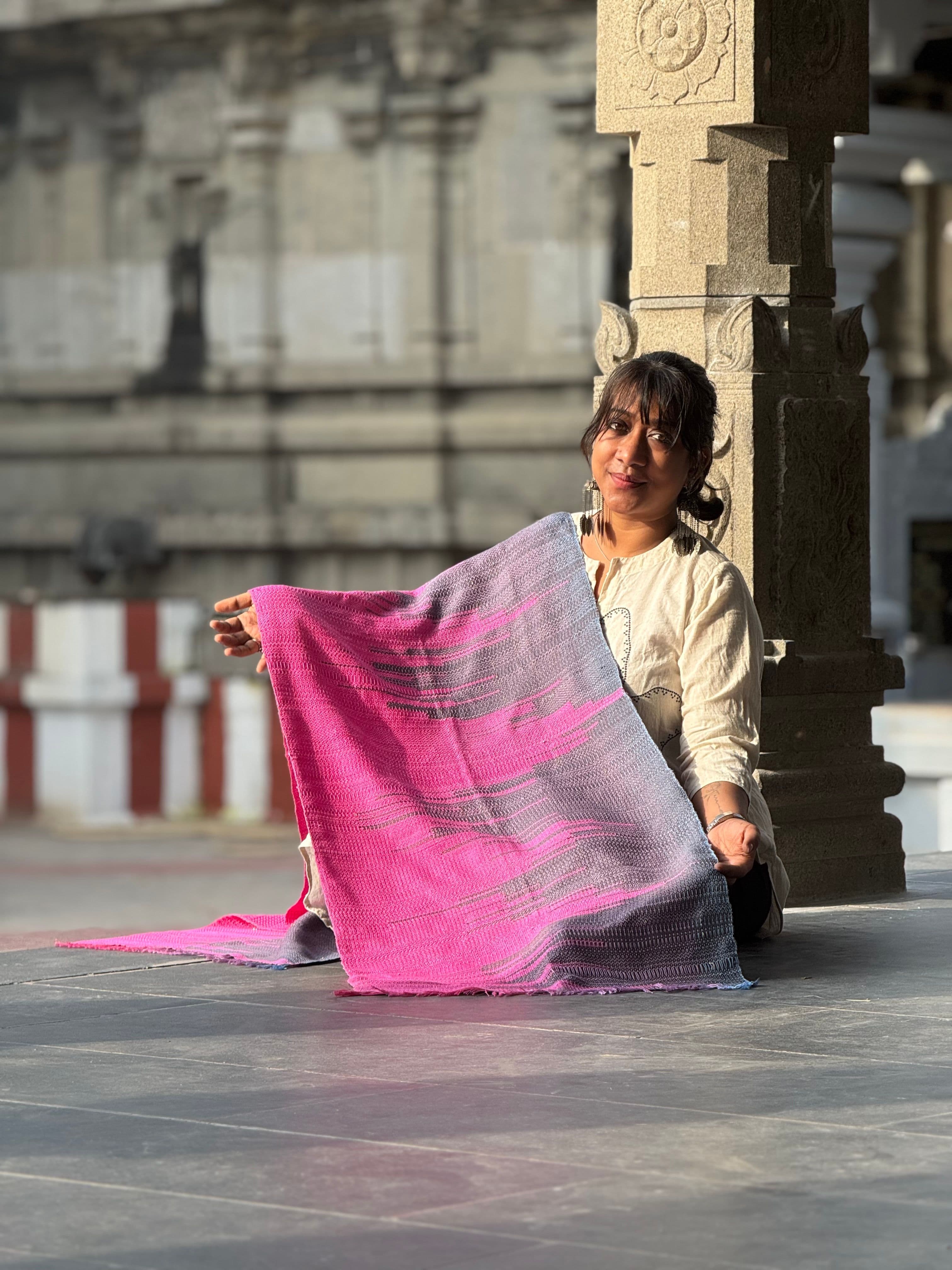
Imagine standing before a piece of woven fabric and realising that what you are looking at is, in fact, a song. Not a painting of a song. Not a chart explaining a composition. A song translated thread by thread into colour, rhythm and texture.
During a training session at Shuttles and Needles, Ms. Sahana Ramanathan, our Carnatic music teacher, found herself surrounded by the rhythmic hum of looms instead of the familiar drone of the tanpura. Her work usually revolves around sound, phrases, patterns, and the quiet discipline of melody. But that afternoon, a conversation over lunch with the director of the weaving studio opened up an intriguing possibility. He spoke about an earlier project where ragas had been interpreted through fabric.
That conversation sparked a question that lingered: What if an entire song could be woven?
The question marked the beginning of a collaborative exploration between music and weaving. Carnatic compositions have often been described as architectural in nature, unfolding through carefully structured phrases and balanced proportions. The composition that came to mind was Rangapura Vihara, set in the raga Brindavana Saranga. With its serene and devotional mood, the raga seemed well suited to be interpreted visually through fabric.
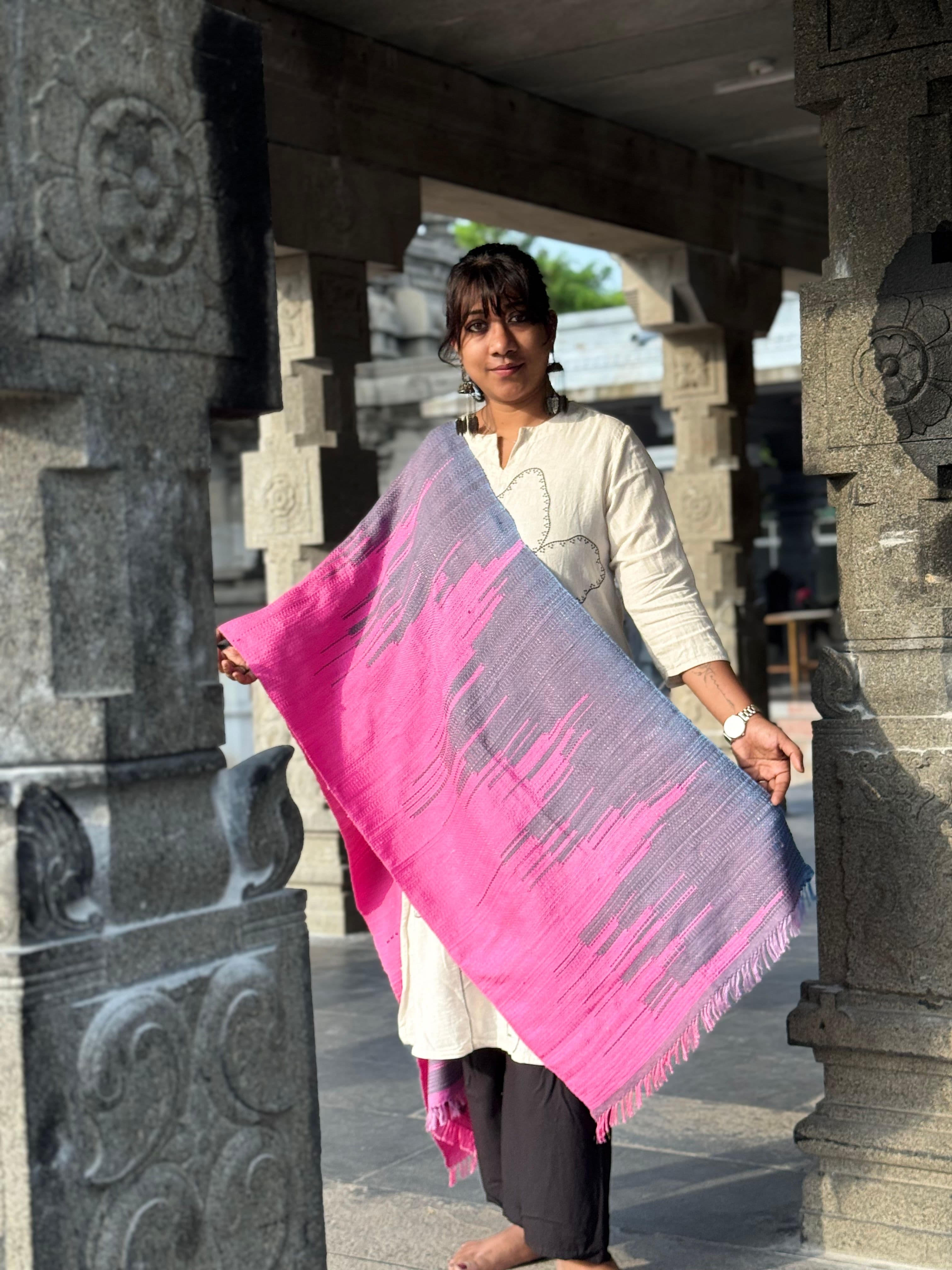
Translating music into weaving required thoughtful experimentation. The process began with understanding the raga’s emotional character; its tonal quality, grace and the way its phrases rise and fall. From there came the challenge of aligning sound with colour. Drawing from colour theory, hues were selected to reflect the raga’s calm and luminous nature. The structure of the fabric mirrored elements of the music itself. Cotton formed the warp, providing a simple and stable base, while silk in the weft added a subtle sheen. Each swara was marked with fine gold threads, giving the notes a visual presence and highlighting the progression of the melody. Colours were graded to reflect ascending and descending movements, creating a rhythm that could be seen even without sound.
Working on a four-shaft loom allowed the patterns to remain fluid, echoing the improvisational nature of a raga. The steady motion of the shuttle carried its own quiet rhythm, not unlike the role of tala in anchoring a musical composition. As the weaving progressed, the parallels between music and textile became increasingly apparent: the warp providing structure, much like tala, while the weft moved through it freely, shaping melody and expression. Additional elements were introduced along the way, including small beads reflecting the playful presence of Krishna celebrated in Rangapura Vihara. Slowly, the fabric began to embody the movement and mood of the composition, a visual and tactile interpretation of music.
This exploration also connects closely with the school’s weaving programme, where students from Grades 6 to 8 engage in hands-on weaving sessions every Saturday. In these classes, students learn the fundamentals of working on looms and go on to create their own woven pieces, developing both skill and creative confidence over time. Within this context, collaborations with organisations such as Shuttles and Needles and projects like this offer a broader perspective on how weaving can intersect with other disciplines, including music.
At its heart, the project is a reminder that creativity often emerges when disciplines meet, when a melody inspires a pattern, and when threads begin to echo the movement of sound.